


Black Belt, Alabama
Discover Alabama's Black Belt
A Region Rich in History, Culture, and Possibility
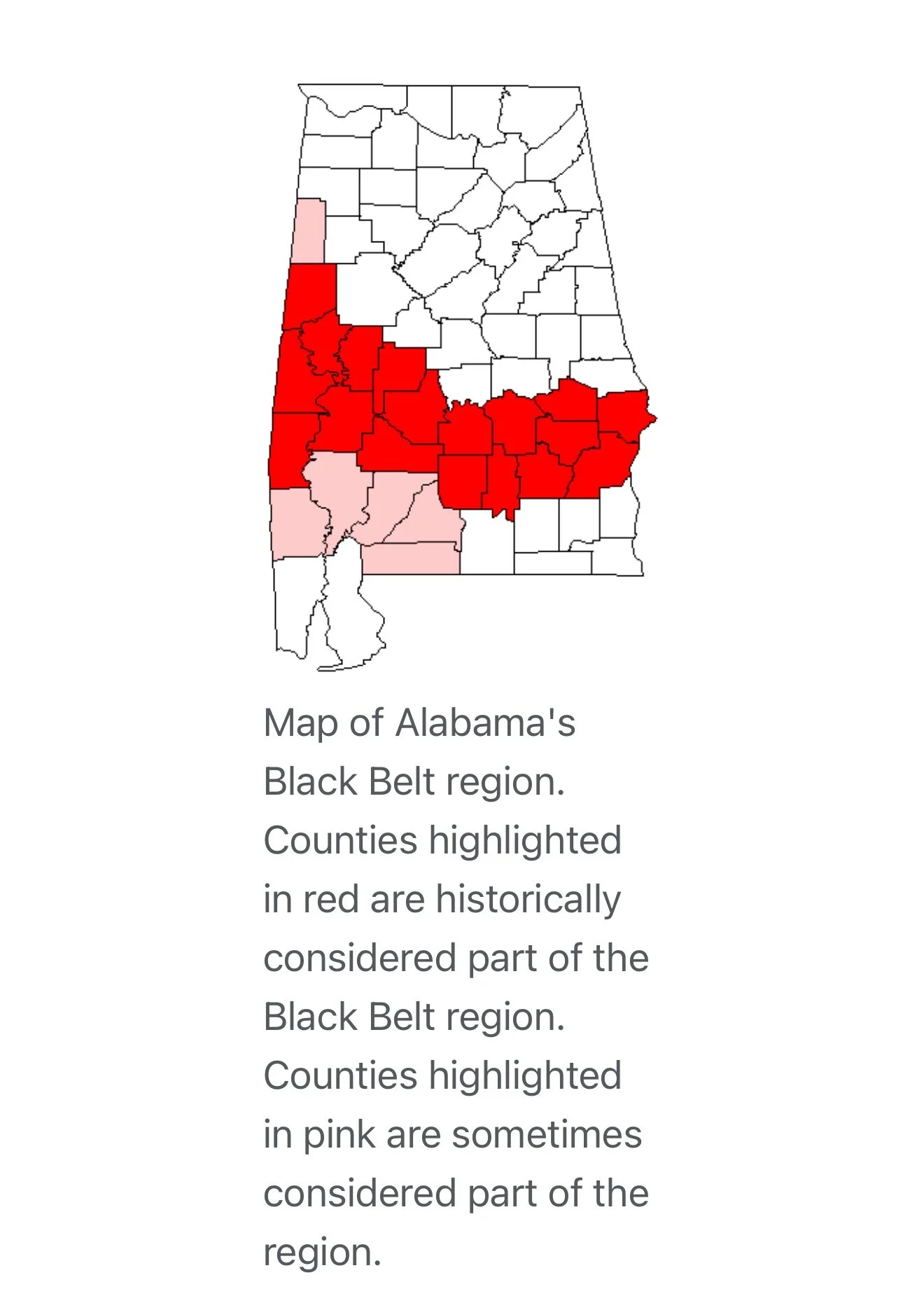
Beginning in north-central Mississippi, the Black Belt arcs to the southeast in a crescent, crossing the Alabama state line in the middle of the state. It continues its trek eastward, tapering off at the Georgia line. The Black Belt is named for the dark color of its rich, fertile soil. Seventy-five million years ago, the Black Belt was the shoreline of a shallow sea, where layers of shells and organic matter formed a dense chalk foundation. Over time, this chalk helped create the rich, dark soil that gives the region its name.
The towns of the Black Belt have witnessed war, segregation, poverty, sharecropping, boycotts, the Civil Rights Movement, and economic decline. But each town has had its share of rebuilding, renewal, and reconciliation. There have been revivals, weddings, parades, festivals, christenings, baptisms, and Christmas tree lighting ceremonies. There have been funerals, protests, marches, arrests, rallies, and destruction. But through it all, the structures that create the towns—the buildings, fountains, bridges, churches, squares, parks, stores, statues, and monuments—provide the citizens of the region with a sense of place and instill a sense of community that ties many people to the area.
Folks are moving to the region to experience what makes the Black Belt unique. They bring new ideas and combine them with what the region has to offer—its land and its people—to create new products. Black Belt Treasures promotes the artists of the region by bringing their work together at the Black Belt Treasures Cultural Arts Center in downtown Camden, Wilcox County. Black Belt Treasures has worked to promote the unique art of the region, in all its forms, creating a mecca for anyone interested in learning about the Black Belt and understanding what makes the region so special. - Excerpts taken from Visions of the Black Belt, Special thanks to author Valerie Pope Burnes
Explore the History and Art of Alabama's Black Belt
Greensboro sits at the heart of a remarkable collection of historic landmarks, internationally recognized architecture, cultural institutions, and artistic communities. Within approximately an hour's drive, visitors can experience some of the most significant places in Alabama's history.
Driving times are approximate from downtown Greensboro. Some historic properties are privately owned, and museum access or tour availability may vary.
| Destination | Significance | Approx. Drive |
|---|---|---|
| Greensboro Historic District | Nearly 150 nineteenth-century structures, historic storefronts, and architectural landmarks | In town |
| Safe House Black History Museum | Where Dr. Martin Luther King Jr. took refuge from the Ku Klux Klan in 1968 | In town |
| Magnolia Grove | Preserved 1840 Greek Revival mansion and historic house museum | In town |
| Greensboro Opera House | Historic performance venue and architectural landmark | In town |
| Auburn University's Rural Studio | Internationally celebrated design-build architecture program with projects throughout Hale County | 15–30 min |
| Newbern Library, Town Hall, and Firehouse | Acclaimed examples of Rural Studio's community-centered architecture | 15 min |
| Perry Lakes Park | Natural preserve featuring innovative Rural Studio architecture and a birding tower | 20–30 min |
| Historic Marion | Historic town square, churches, and significant nineteenth-century architecture | 25–30 min |
| Reverie and Carlisle Hall | Notable nineteenth-century architectural landmarks in Marion | 25–30 min |
| Alabama Military Hall of Honor | Museum celebrating Alabama's military history | 25–30 min |
| Moundville Archaeological Park | National Historic Landmark preserving one of North America's most important Indigenous mound complexes | 35–45 min |
| Gaineswood | National Historic Landmark and celebrated Greek Revival house museum in Demopolis | 35–40 min |
| Bluff Hall | Historic house museum overlooking the Tombigbee River in Demopolis | 35–40 min |
| Demopolis Historic District | Historic homes, public squares, and riverfront heritage | 35–40 min |
| Edmund Pettus Bridge | Nationally significant landmark of the 1965 Selma voting-rights marches | 45–55 min |
| Selma's Civil Rights Historic District | Brown Chapel AME Church, First Baptist Church, and other landmarks central to the voting-rights movement | 45–60 min |
| Old Cahawba Archaeological Park | Preserved ruins and landscape of Alabama's first state capital | Around 60 min |
Find Your Place in the Black Belt
Across the Black Belt, a new generation of artists, entrepreneurs, preservationists, and community builders is breathing fresh life into historic towns while honoring the people and traditions that make this region extraordinary. The Forney Group is proud to be part of this revival, helping people recognize the beauty, opportunity, and potential in places that have so much history and so much future. Whether you're drawn to a historic home, a downtown storefront, or a place to build something entirely new, The Forney Group would be delighted to help you find your place in Alabama's Black Belt.